
Advertisement
Behind the cookbook: Sacred Food
17 August 2026 · Behind the Cookbook
Elisabeth Luard is the author of more than 20 books. A particular focus through her career has been in depth research into the anthropology of food, and regional traditions involving food throughout the world. In this Behind the Cookbook series she tells the story of how she came to write Sacred Food: Cooking for Spiritual Nourishment, first published in 2001 and now available on ckbk. As well as being a writer, Luard is also an illustrator and watercolorist, and ckbk’s re-release of Sacred Food includes a number of Luard’s own illustrations.
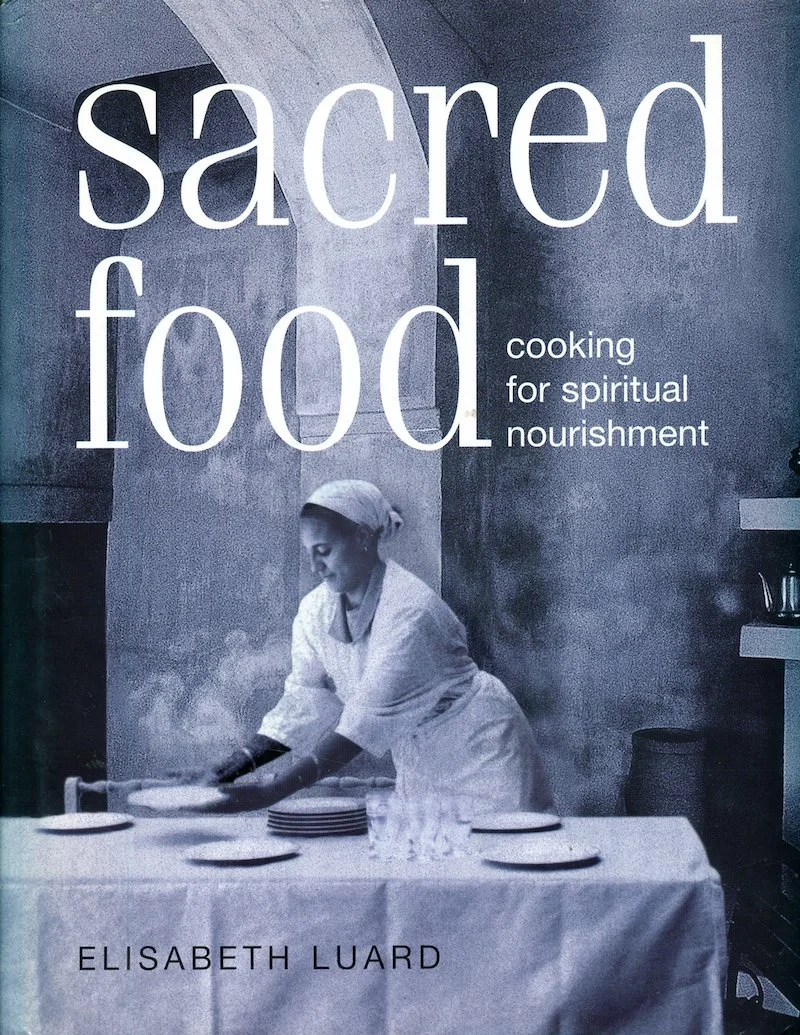
The main attraction, believe it or not, was a six-month deadline to deliver what by rights should take a lifetime. Add to that a workable advance, an editor who trusted my judgement, and—well, I do love a challenge... Nevertheless, a subject as wide-ranging and potentially contentious as Sacred Food is not for the faint-hearted. Happily the subtitle, Cooking for Spiritual Nourishment, narrowed the field to whatever it is we set on the table to celebrate or mourn or mark a moment of importance in our lives.
If regional culinary habits were—still are, when we go back to our roots—dictated by latitude, landscape and trade-routes. I'd already explored the basics of what we do when we need to remember who we are when researching European Peasant Cookery (1985), published in the US as The Old World Kitchen, owing to American sensibilities—yes indeed!—and its two companion-volumes, The Barricaded Larder and European Festival Food.
All three were published in the 1980s and are still in print (sometimes under a different title—confusing, but the work is still the same). Much of what was then true of the rural way of life—self-sufficient, independent, resilient—has changed over the intervening years. Urban has largely replaced rural: few now work on the land—no one wants to live in a museum or work themselves into an early grave. But those who left a way of life that was no longer viable brought their celebrations with them, reviving family memories through the rituals of the table. Meanwhile, municipal authorities developed these imported traditions, regional and local in origin, into income-generating festivals that don't always reflect the original purpose. Those memories that survive can most clearly be seen in the Jewish tradition: when I asked Claudia Roden, out of curiosity, why so many of us food-writers have a Jewish line of descent, her answer was simple: "Diaspora. We need to remember who we are."
My earlier career as a natural-history artist—birds and botany—taught me how to read a landscape and take note of what can be grown, gathered or husbanded. A new career as a food-and-travel journalist and a cookery column in The Field—yes, I already knew how to skin a rabbit—gave me, lacking a university education, the freedom of the London Library's open shelving—imagine that! Topography rather than the cookery-shelves led me deep into 19th century travellers' tales. The most rewarding were those written by lady-travellers and the Reverend—women and vicars are careful with their money, travel by road, visit places overlooked by those interested in battlefields and castles, take lodgings in farmhouses, talk to their hosts, arrive hungry… and take note of what's for dinner.
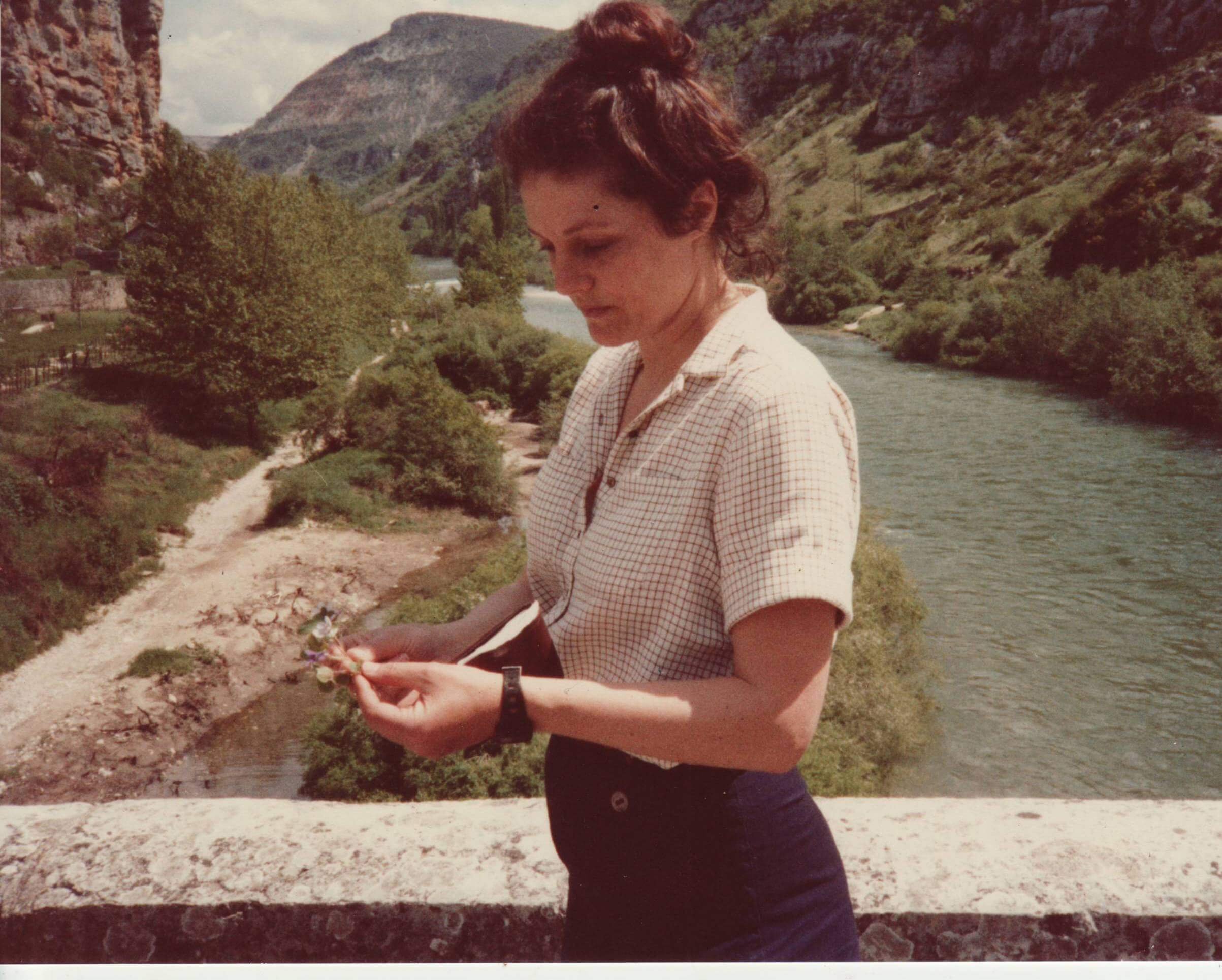
Working as a botanist in 1978
Working on Sacred Food with material gathered on the road when travelling for the earlier books, and from my own experience as child in the post-war years and bringing up my own children in Spain and France, it seemed obvious that my own first-hand experience could be matched to the historical accounts, some of which are quoted in the text. And since my methods of working are somewhat nineteenth-century—I travel with sketchbook and paints rather than a camera—I have always been able to ask questions visually in places where I don't have the language.
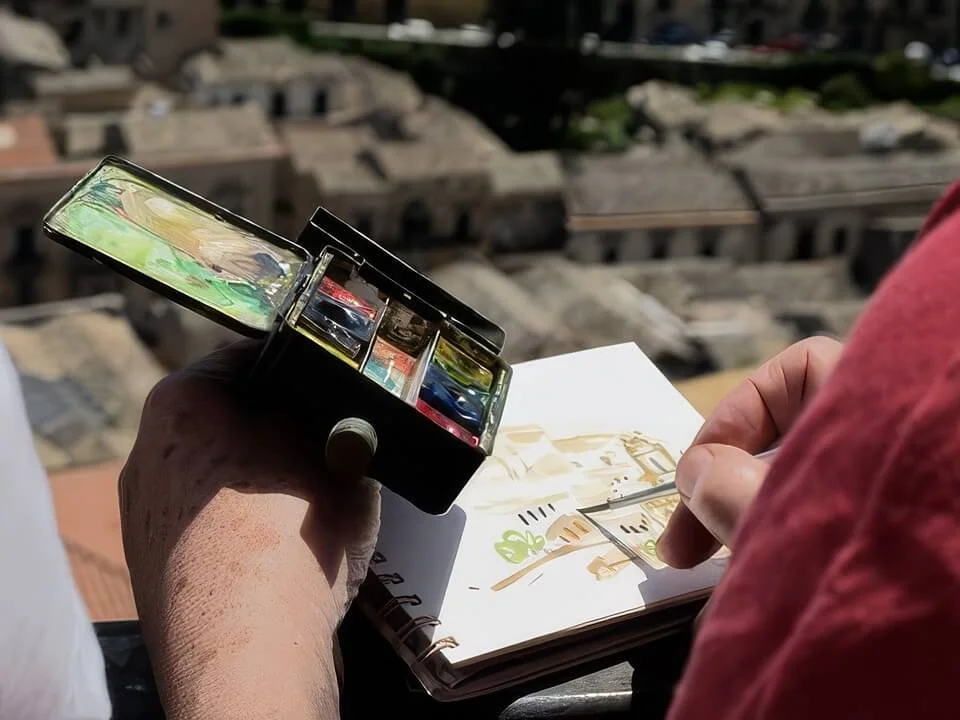
The author/illustrator in action
Several years after first publication, European Peasant Cookery provided the basis for a TV series, The Rich Tradition, with 13 half-hour episodes produced for SBS Australia to satisfy an audience of immigrants nostalgic for a taste of home. The series was also shown by the BBC and a good many other broadcasters, and is still out there and can be watched online both on YouTube and at Talking of Food. It’s a reminder of who and where I was thirty years ago—even if I do sound rather like the late (and indeed the present) Queen.
The series was filmed during the spring and summer of 1991 and 1992, on location throughout Europe, at a time when the Soviet Union was collapsing and traditional ways of life were vanishing as fast as snow in summer. We were a small group by TV standards (six, including me as writer-presenter), and the only plan was to trust that I would know what we were looking for when we got there, and that the location would tell its own story. Which indeed it did. There was always a moment when there was something to celebrate—a religious festival, a wedding, a birth—to provide a reason for young and old to gather together around the kitchen table and make sure the old ways weren't lost.
Sacred Food had its beginnings in what I already knew (or had learned from the work of others) about the role of food in religious ceremonies. I include recommendations for further reading rather than a more detailed bibliography. But, as the subtext Cooking for Spiritual Nourishment makes clear, at its heart it is a cookbook. As with any practical cookbook, I hope that the recipes will tell you how to use and what to expect from ingredients which may not always be familiar, and how to achieve a result that tastes delicious. And that's before we get to the serious business of what we share: how to deliver what makes us who are through the dishes we set on the table, the stories we hold in common.
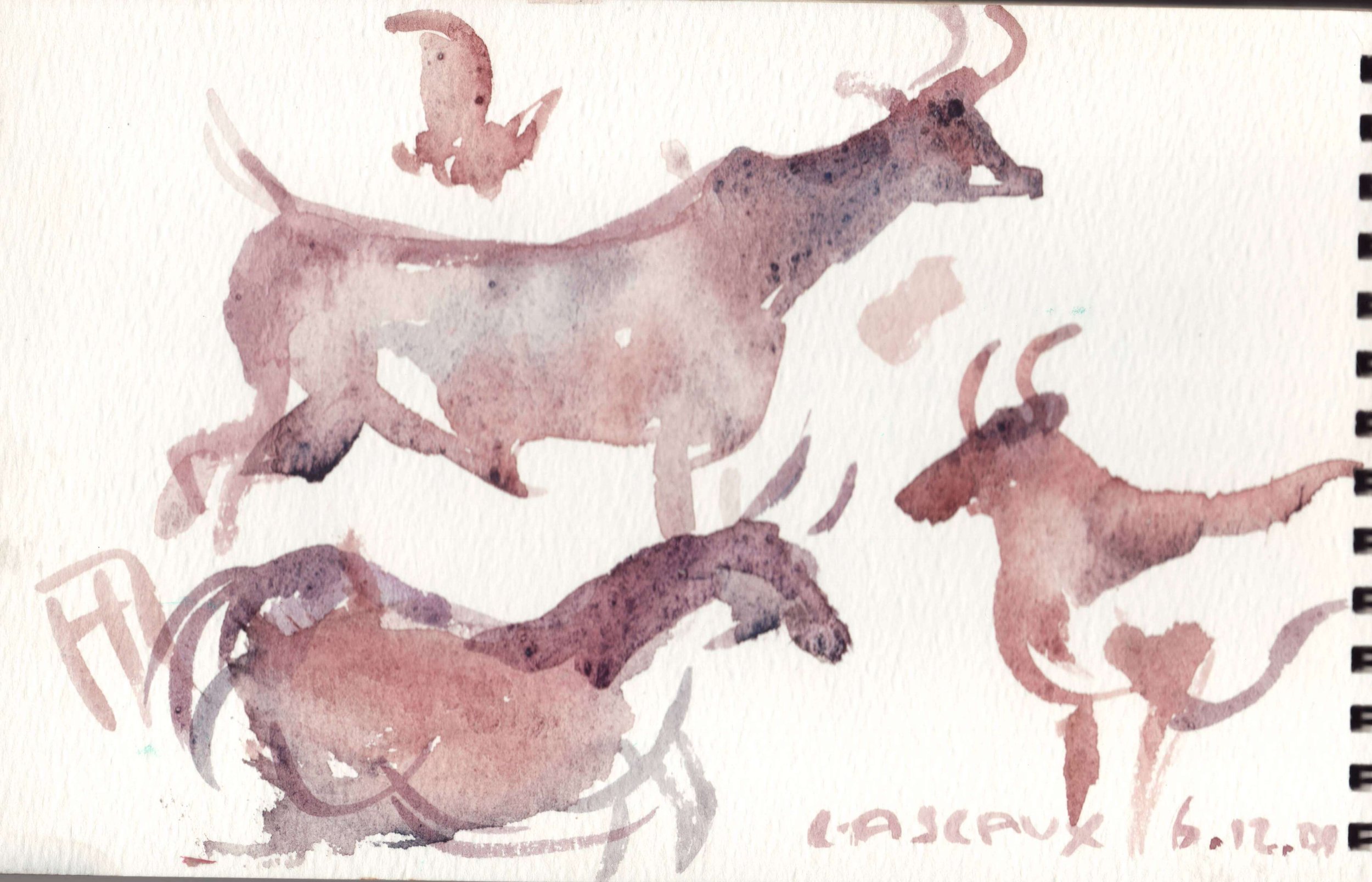
The black-and-white drawings included in this new, all-dancing, all-singing, on-line edition were prepared from my sketchbooks in much the same way that your ancestors and mine painted what looks to me like a wish-list for a party on the walls of the Lascaux caves: “I'll take a couple of the little ones with the horns, and one of the big plodding ones with the hairy feet, and don't come home without 'em.” Yes, well. Back to the cooking-fire at the cave-mouth. Which, when all is said and done, is where it all began…
A few of the celebatory dishes featured in Sacred Food
Pashka (Russian Easter Cheesecake)
Bacalao de los Muertos (Mexican All Soul’s Day Salt-Fish)
Paella de Campo (Andalusian Country Paella, from the Spanish pilgrimage trail)
Ashak (Afghan Betrothal ravioli)
Santa Lucia’s Peppersnaps (Swedish Christmas Cookies)
Galette des Rois (French Epiphany Cake)
Berliners (German Carnival Donuts)
About the author
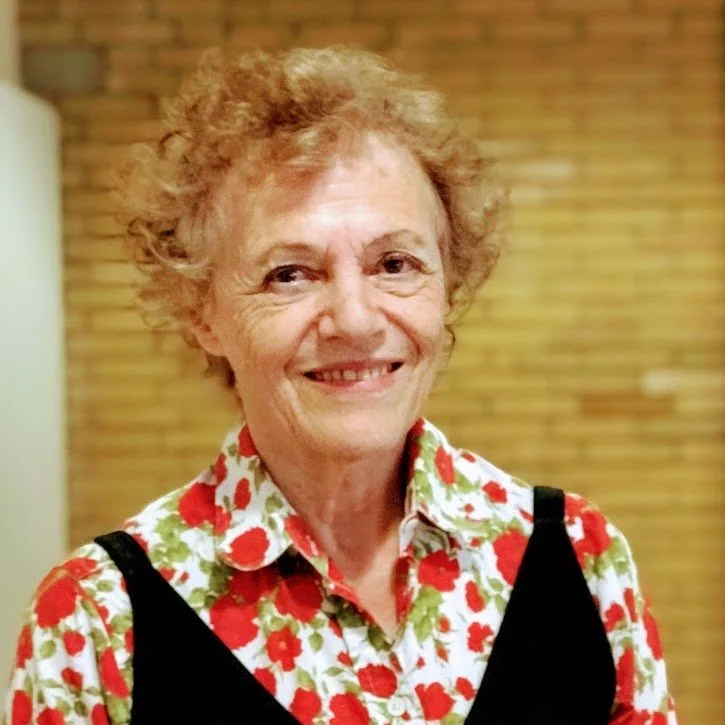
During a forty-year career as writer and illustrator, Elisabeth Luard has published some twenty cookbooks including European Peasant Cookery (Published in the US as The Old World Kitchen), Sacred Food, The Regional Cooking of Spain and Portugal, Flavours of Andalucia and A Cook's Year in a Welsh Farmhouse; plus a couple of novels (Emerald and Marguerite) and four memoirs with recipes including Family Life, My Life as a Wife, and the most recent, Squirrel Pie and Other Stories. Her work as a natural history artist has included two one-woman shows at the Tryon Gallery in London's Cork Street and illustrations for Dr. Miriam Rothschild's The Butterfly Gardener. Work for TV includes a 13-part series, The Rich Tradition, filmed on location round Europe and available free at Talking of Food. Contributions to newspapers and magazines include Country Living, Daily Mail, House & Garden, The Scotsman, Daily Telegraph. Current work includes a cookery column with illustration in The Oldie magazine. She was awarded The Guild of Food Writer's Lifetime Achievement Award in 2016 and is the current President of the Oxford Food Symposium. Prints of her work as an culinary artist/illustrator are available from her website.
Elisabeth Luard discusses Sacred Food at the Ballymaloe Literary Festival in 2016
More ckbk features
Pastry Chef Luciana Corrêa shares her tips for successful cake baking
A lean, healthy and sustainable option, wild venison is experiencing a surge in popularity

Charlie Cart founder Carolyn Federman concludes her series on cooking with junior chefs, with a feature on dishes for celebrations
Advertisement